
Overview
The tables under the Utilization tab will help you to perform a detailed analysis of the selected physician's performance with regard to hospice care for his patients.
 Chart View
At the top left of the page you will find a toggle icon that allows you to turn chart view on and off. With chart view on, the chart is shown for the metrics and the table of metrics will not be shown.
Chart View On |
Chart View Off |
 |
 |
|
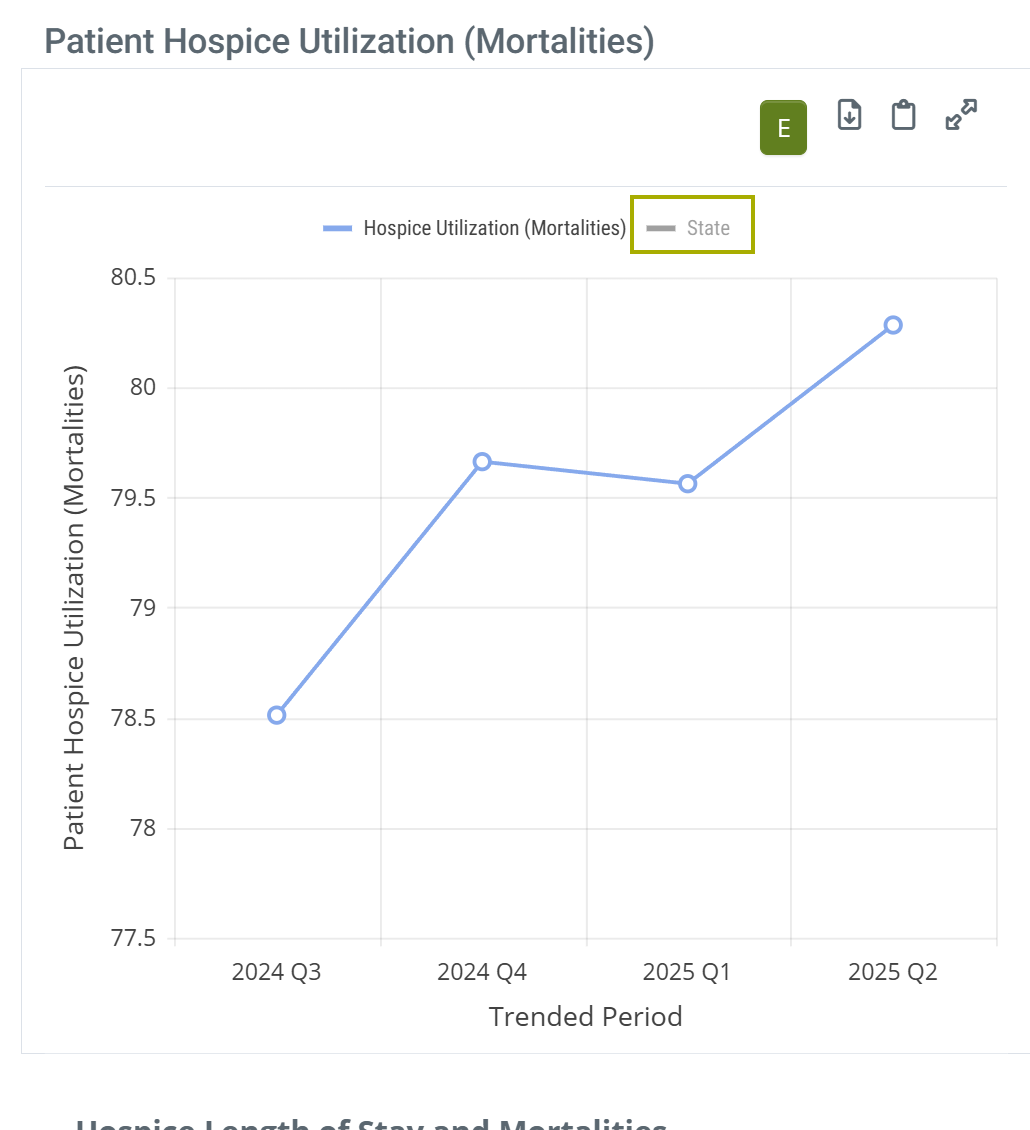
Legend - Each chart has a legend that identifies the elements in the chart. Each different identifier in the legend can be toggled on and off to display or hide the matching elements in the chart
| |
 |
 |
 In this article
There are four tables under the Utilization tab. The names of each are shown in the following navigation along with summaries.
- Patient Hospice Utilization (Mortalities) table - counts of the aggregated flow of patients who were treated by the selected physician to hospice
- Hospice Length of Stay and Mortalities table - length of stay and mortality counts for patients treated by the selected physician
-
Hospice Timing panel
- Value- summary of the value of the content in the Hospice Timing panel
- Panel Settings
- Chart View - you can view the Medicare Cost of Care content as a table or a chart
- Filters - you can select a very specific patient population to evaluate
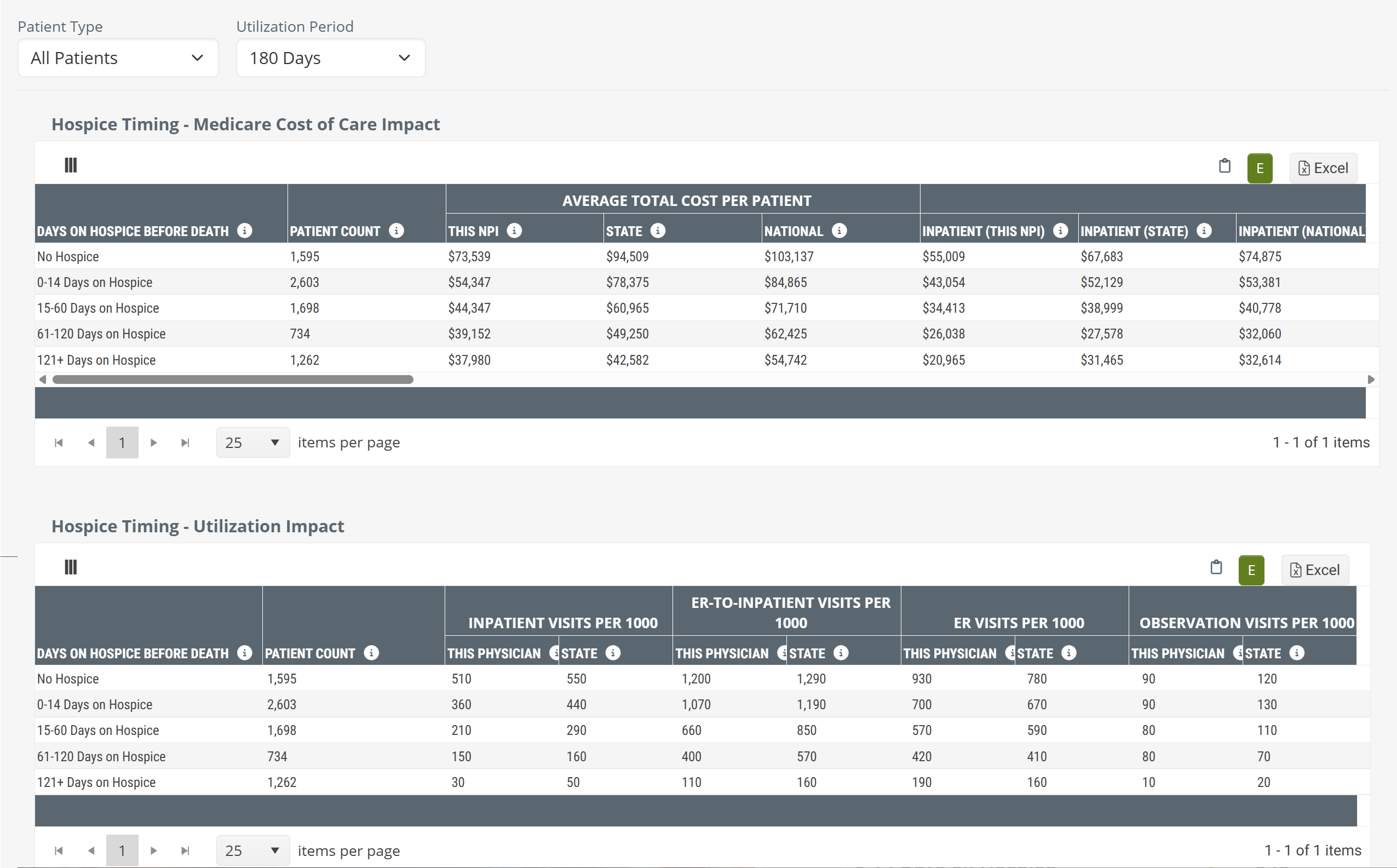
- Hospice Timing - Medicare Cost of Care Impact table - a visual analysis showing how earlier and longer hospice enrollment correlates with lower overall Medicare spend and reduced healthcare utilization in a patient’s final months of life
- Hospice Timing - Utilization Impact table - for patients treated by the selected facility, the table shows metrics for patients who received early hospice care, late hospice care, and no hospice care to prove the value of early hospice care.
Patient Hospice Utilization (Mortalities)
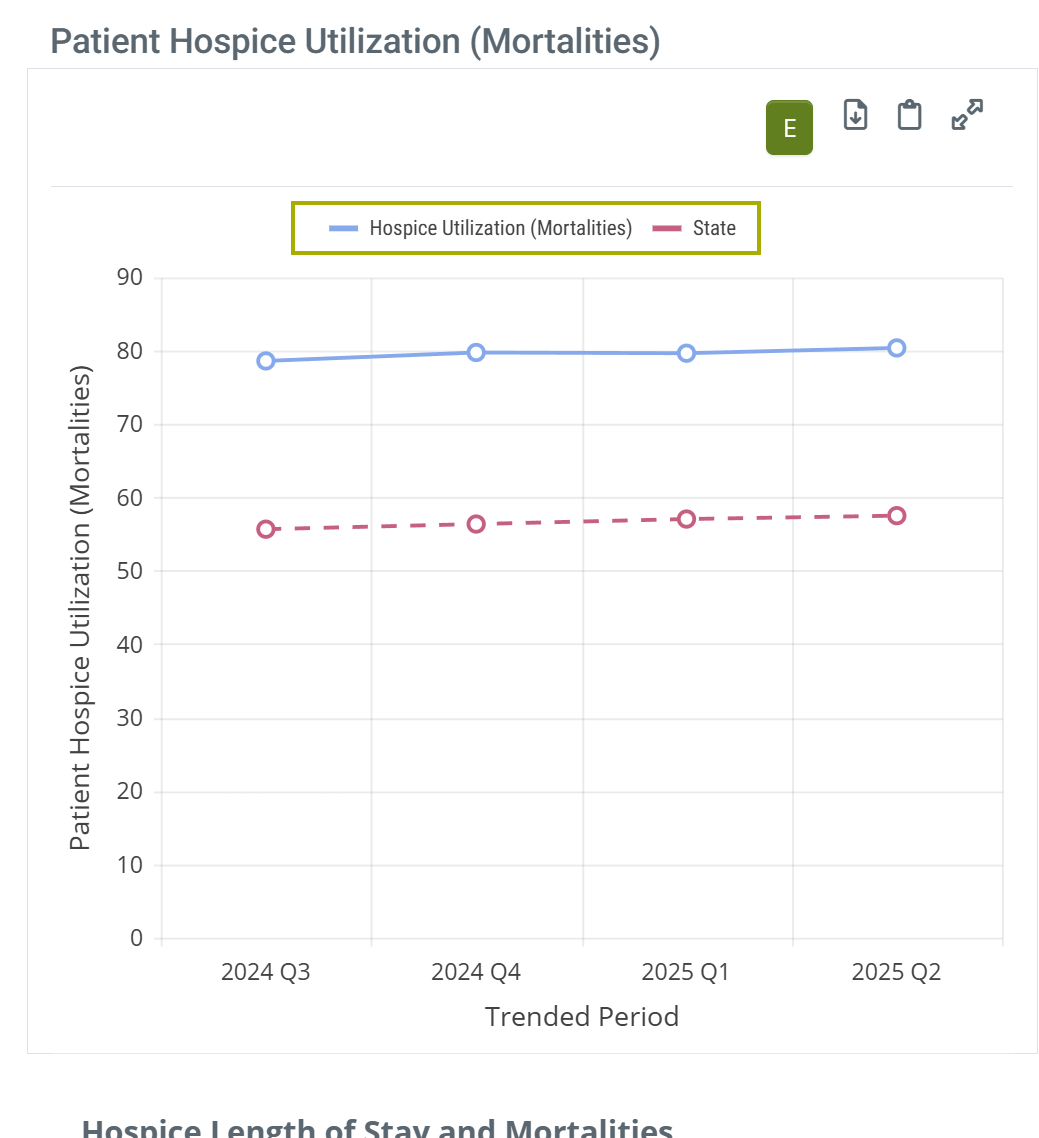
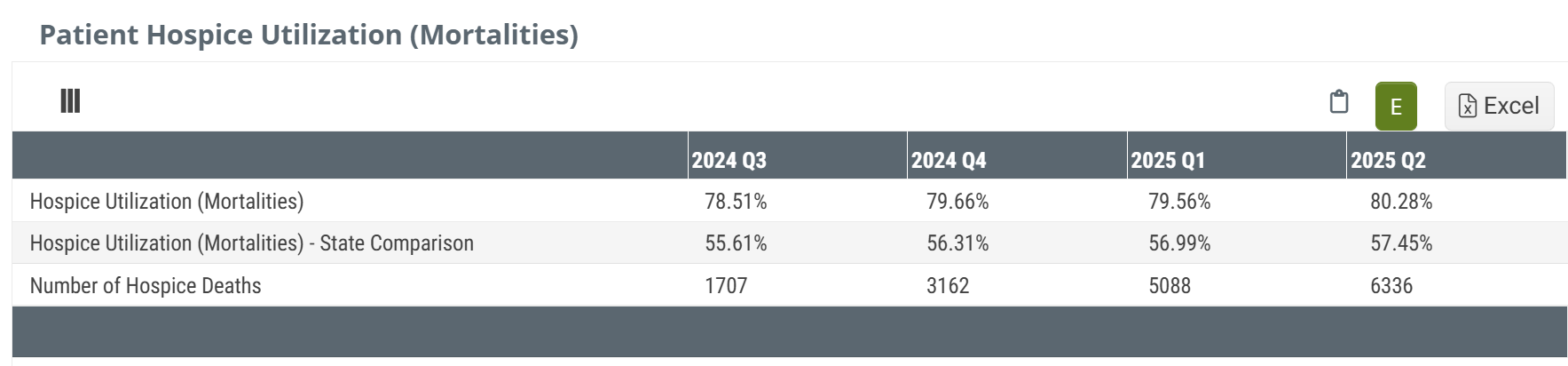
The metrics in this table and chart show the four quarter trended hospice utilization percentages for patients treated by the selected physician. State average percentages for the same four quarters are provided for comparison. In the table, mortality counts for patients treated by the selected physician are also trended.
 Definition
Each metric for the physician is the percentage of the patients treated by the physician within the six months prior to their death who received hospice care and died during the reporting period listed in the header. The state average is calculated for patients of all physicians with the same specialty in the same state of registry for the selected physician. Mortality counts are made from the date of death in the quarter listed in the column.
|
Off
|
 |
|
|
On
|
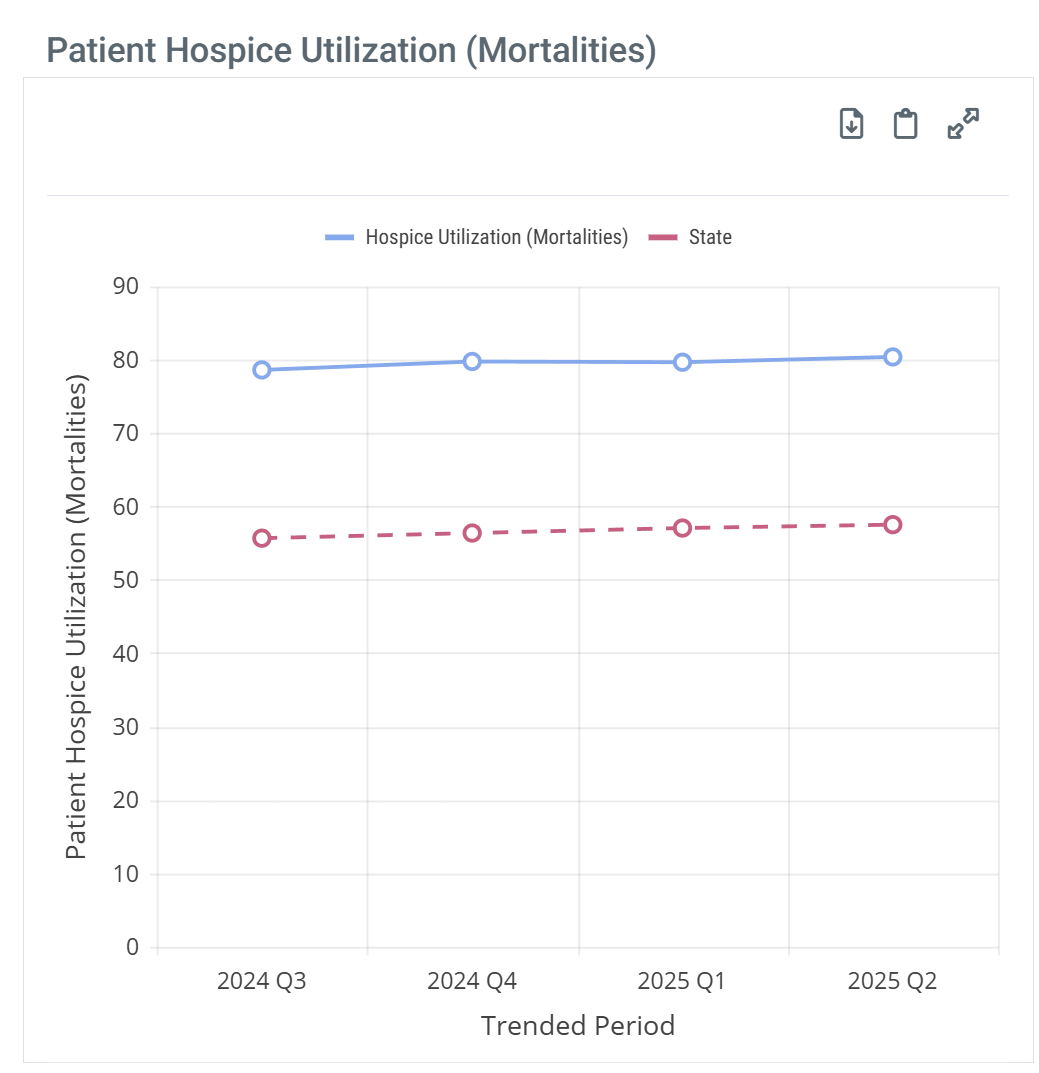 |
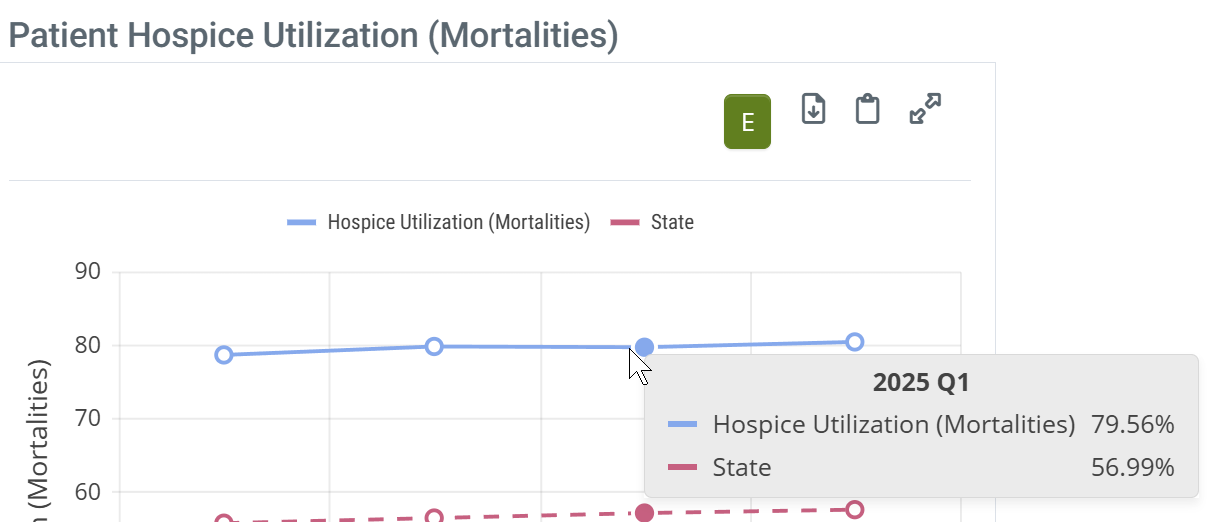
When you hover over a column in the Patient Hospice Utilization (Mortalities) chart, the metrics for the data points for the trendlines are displayed. (image below) |
 | ||
 Value
Value
The Hospice Utilization metric shows the percentage of patients treated by the physician who received some measure of hospice care. Although it is impossible to expect that 100 percent of hospice appropriate patients will be admitted to hospice care, the hope is that a physician would attain the highest possible percentage of patients to receive hospice care. With that in mind, we can use the metrics in this table to evaluate the selected physician's success in getting patients into hospice care, and we can compare performance against other physicians. The images above show that the selected physician is doing a stellar job with metrics that hover around 80 percent hospice utilization. The selected physician modeled above beats the state average by more than 20 percent.
 This metric does not break out the length of stay for the patients included in the metrics. The remaining tables under the Utilization tab break out length of stay in great detail
Understanding the Metrics
Although not all of the metrics shown in the table are included in the chart, the metric definitions below include all of those in the table or the chart.
Metric Name |
Description |
| <<First Column>> Unnamed |
The first column identifies the metrics shown in each row of the table. Most tables in Trella Insights have metric definitions in the header or each column. Since the columns are different quarters for which the trended metrics are calculated, there are no definitions for this table. The definitions below apply to the three different rows in the table |
| Hospice Utilization (Mortalities) | This is the percentage of the patients treated by the physician within the six months prior to their death who received hospice care and died during the reporting period listed in the header. This metric is calculated independent of length of stay. |
| Hospice Utilization (Mortalities) - State Comparison | This is the average hospice utilization percentage for all physicians in the state with the same specialty as the selected physician. |
| Number of Hospice Deaths | This is the number of patients who died in the quarter listed in the column header. The patients in this population are those from whom the metrics in the table were calculated. |
 |
Hospice Length of Stay and Mortalities
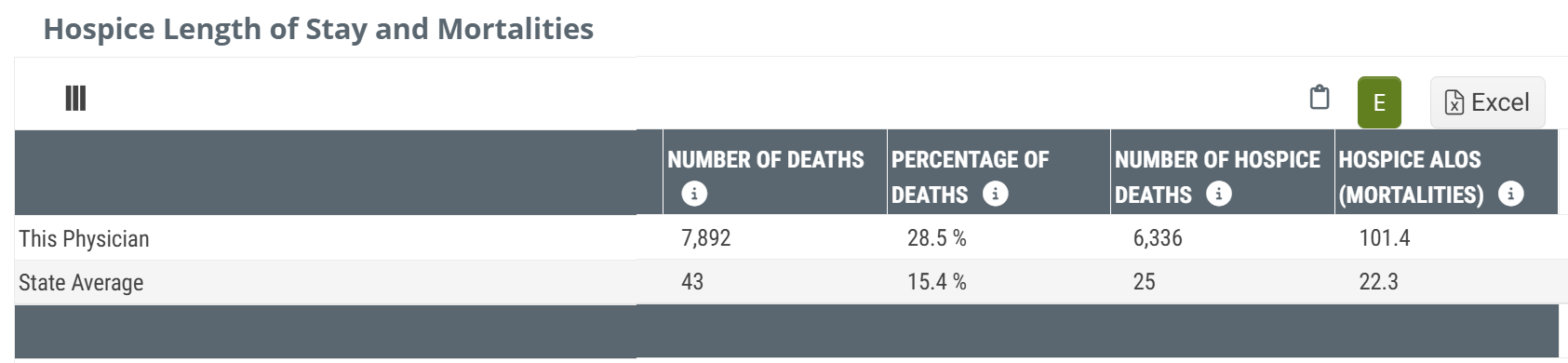
This table provides some critical end of life statistics for patients treated by the selected physician. In many ways, the metrics here are the broadest possible summary of the details in the Hospice Timing panel.
|
Off
|
 |
|
On
|
There is no chart view for the metrics in this table. The table above is shown with Chart View on. |
Metric Name |
Description |
| <<First Column>> unnamed |
The first column indicates the provider(s) for whom the metrics in the row are calculated
|
| Number of Deaths | This is the count of patients who were treated by the selected physician within six months of their death who died during the one year reporting period. |
| Percentage of Deaths |
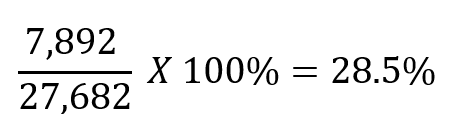
This is the percentage of all Medicare FFS patients treated by the selected physician who were treated by the selected physician within six months of their death and who died during the one year reporting period. To see how this metric is calculated, we use two metrics you can check out. Numerator: the Number of Deaths in the column to the left Denominator: From the Explore page for the same physician, the metric Annual Patient Count (FFS)
The numbers fill in like this.
|
| Number of Hospice Deaths |
This is the count of patients who were treated by the selected physician within six months of their death who were admitted to hospice care and died during the one year reporting period. This count is a subset of the Number of Deaths metric above. The difference is that the patients in this count are limited to those who received hospice care. |
| Hospice ALOS (Mortalities) | This metric is the average length of stay in hospice for the patients who were treated by the selected physician within six months of their death who were admitted to hospice care and died during the one year reporting period. |

|
Hospice Timing panel
The Hospice Timing panel includes two tables that provide a detailed analysis that demonstrates the impact of earlier and longer hospice care. The content in this panel proves that earlier and longer hospice care for the selected provider's patients correlates with lower overall Medicare spend and reduced healthcare utilization in a patient’s final months of life.
 For a full presentation of the metrics and features in the Hospice Timing panel, see Hospice Timing - Cost of Care and Utilization.
Value
Value Summary - It is impossible to overstate how conclusively these detailed hospice timing metrics prove that getting patients into hospice care earlier positively impacts costs and utilization. Consider the following:
 Quantifies impact with real patient data
The tables provide proof that you can provide to referring physicians and facilities how the timing of hospice enrollment affects their own patients spend, utilization, and care intensity.
 Reveals high value education opportunities
The tables demonstrate the impact of late transitions and how they result in unnecessary hospitalizations, readmissions, or higher spend — arming reps with objective, claims-backed talking points.
 Provides state and national benchmarks for comparison
The metrics in these tables contextualize performance against broader trends, helping organizations uncover gaps and opportunities for improvement.
 Supports value-based care alignment
The tables enable providers to demonstrate the financial and clinical benefits of timely hospice enrollment to partners seeking improved quality and coordination.
 The point of all of the metrics in these tables is to prove the value of earlier hospice for dying patients. To do so, all of the costs during the time periods are calculated backward from the deaths of the patients included in the metrics.
|
Panel Settings
There are some basic settings for the Hospice Timing panel that allow you to customize what content is displayed in the panel and how it is displayed. This includes Chart View and Filters.
Chart View
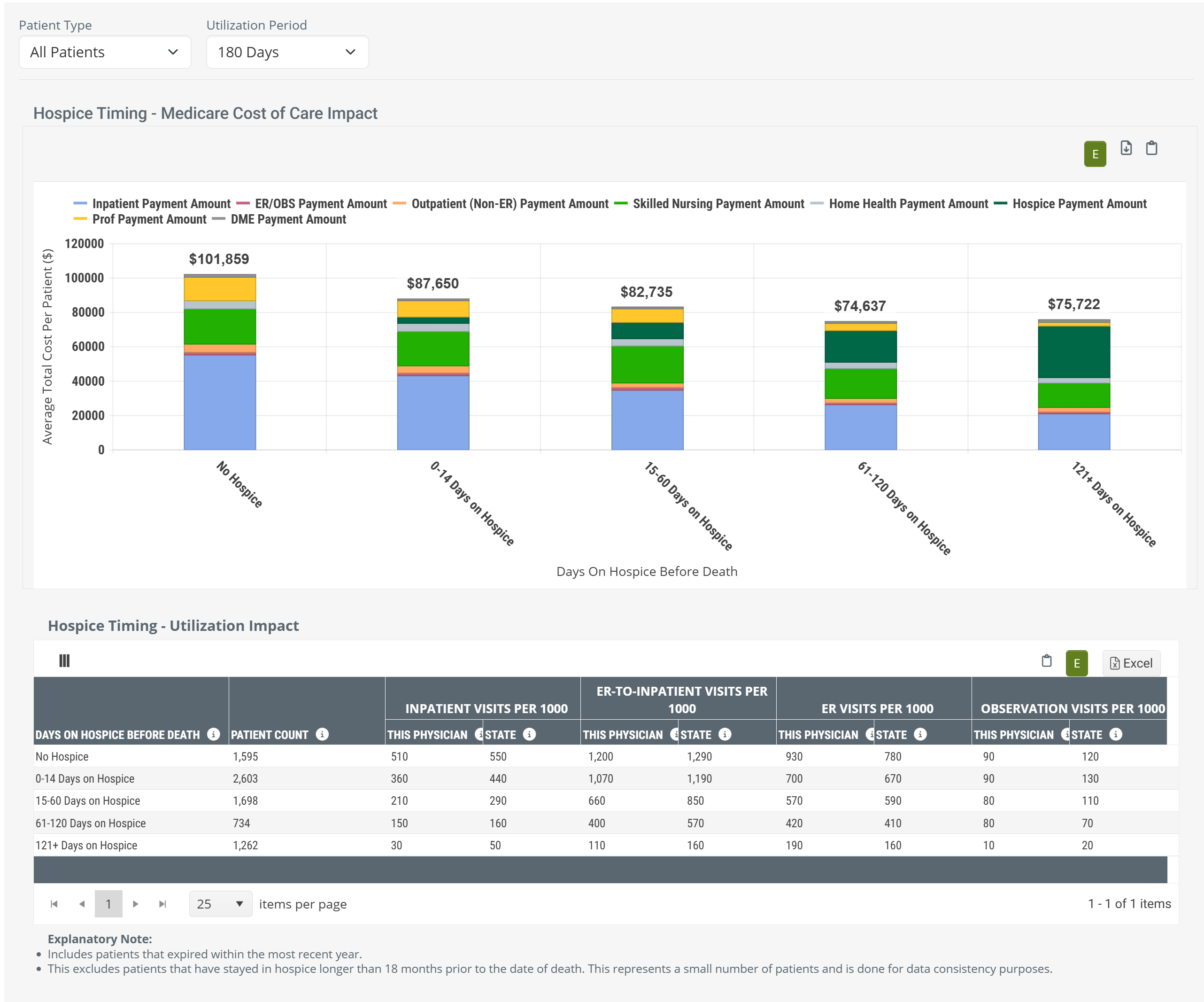
At the top left of the page you will find a toggle icon that allows you to turn chart view on and off. With chart view on, the chart is shown for the Hospice Timing - Medicare Cost of Care Impact table.
Chart View On |
Chart View Off |
|
|
|
Turning on Chart View will make chart view active for content under all tabs on the selected Analyze page. The default mode for the Analyze page is with chart view on. | |
|
Legend - The chart has a legend that identifies the elements in the chart. Each different identifier in the legend can be toggled on and off to display or hide the matching elements in the chart
| |
 |
 |
 |
 |
The following images show the difference between chart view off and chart view on for the Hospice Timing panel.
|
Off
|
 |
|
On
|
 |
Filters
This panel provides flexibility that allows you to evaluate hospice timing for different patient populations for the selected provider. Each dropdown selector is described below.
The specific metrics that appear in the both tables are determined by the choices you make.
|
Patient Types - this dropdown allows you to choose between three patient type categories. Each are described below.
|
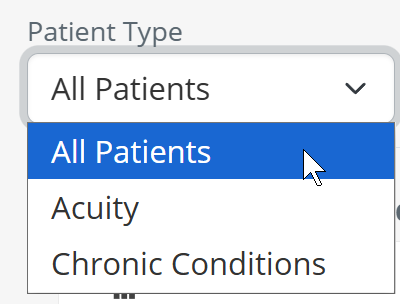 |
| All Patients - with this selection, all patients discharged from the selected provider will be used to calculate the metrics shown in the table. |  |
|
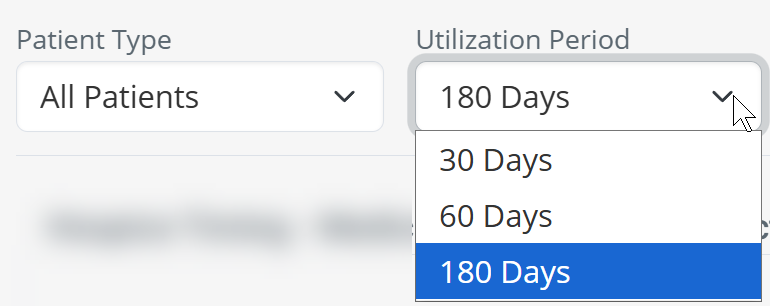
Lookback Period Before Death - You can select the length of time from which patients will be included in the calculations for the metrics in the table.
|
 |
|
Acuity - You can select to filter patients by their acuity.
|
 |
| Acuity Level - if you use the Acuity patient type, you can then use the second dropdown to choose a specific acuity level. | 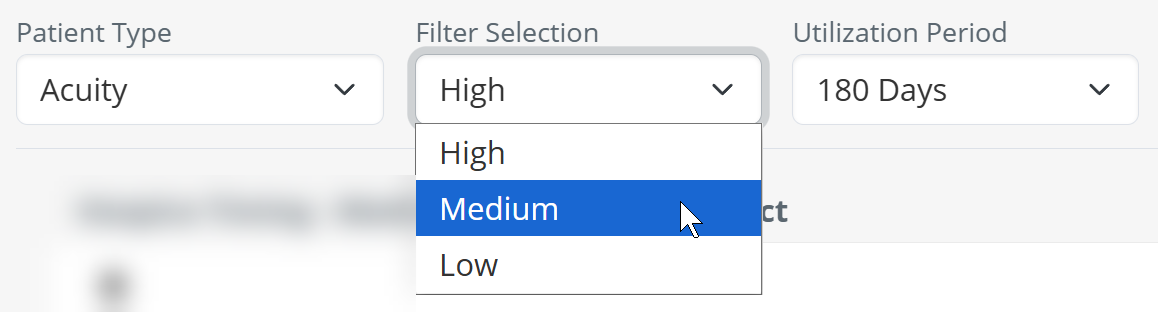 |
| Lookback Period Before Death - once you have chosen an acuity level, you can choose to filter the results in the table to a specific period using the third dropdown. | 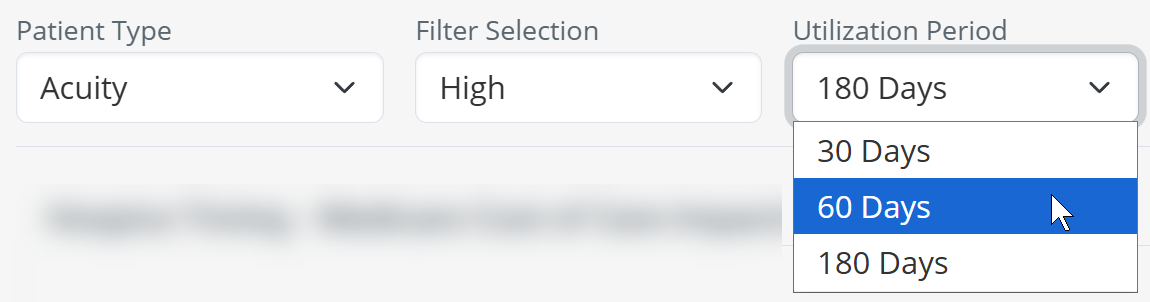 |
| Chronic Condition - the third patient type that you can choose is chronic condition. |  |
|
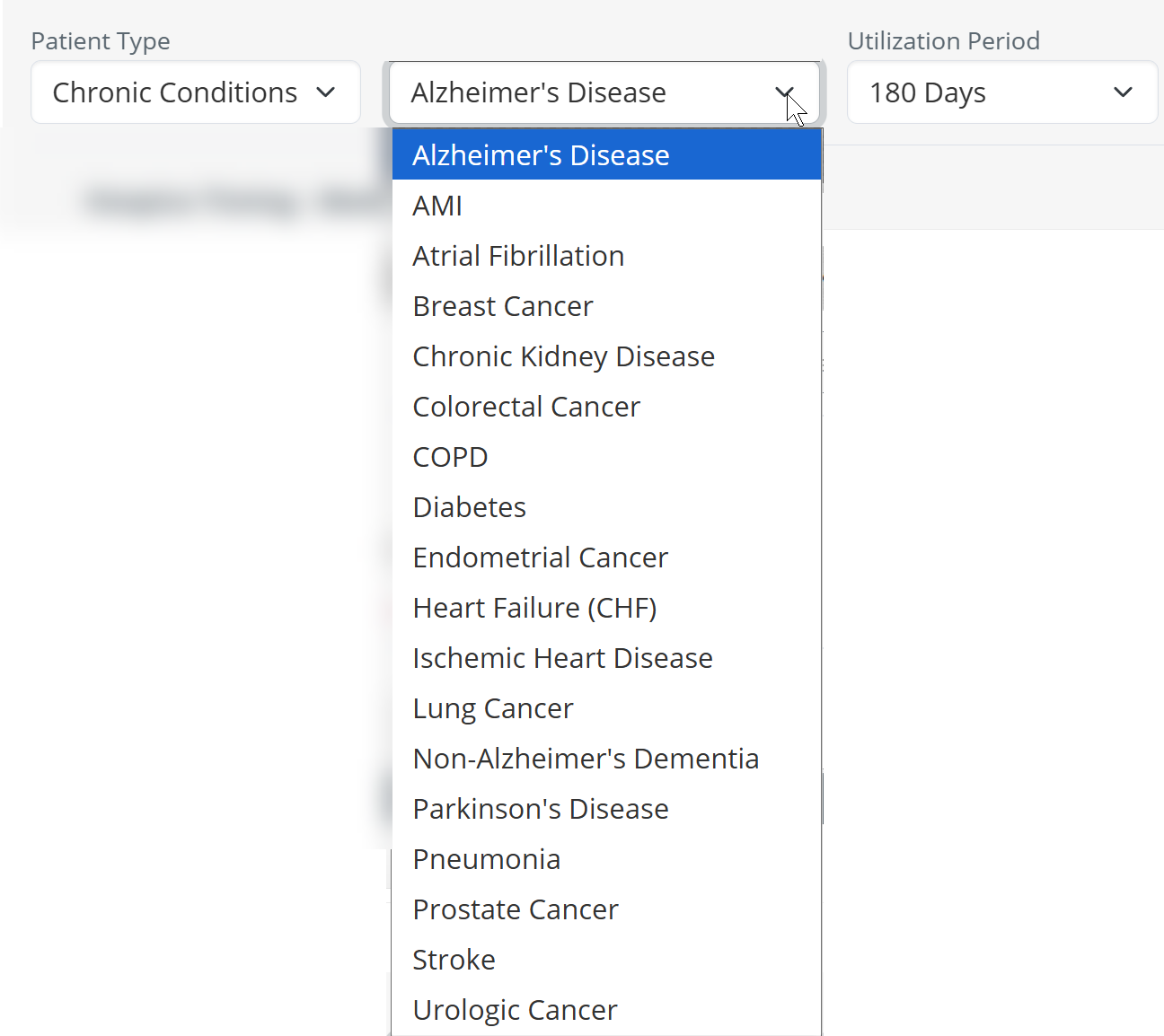
Choose a chronic condition - if you choose the Chronic Condition patient type, you then have the option to select a specific chronic condition from the second dropdown. The chronic conditions available are shown in the image to the right.
|
 |
| Lookback Period Before Death - after you have chosen a specific chronic condition, you can choose to filter the results in the table to a specific period using the third dropdown. | 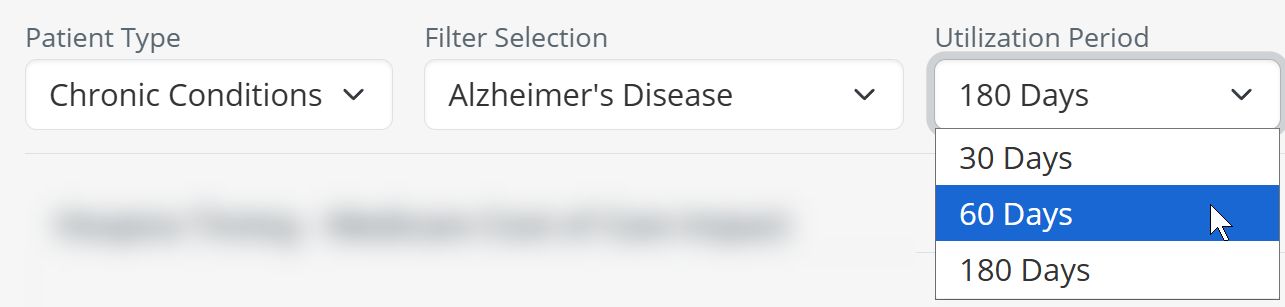 |
Patients included in the counts for the different periods of hospice care could have potentially revoked hospice care, and also been re-admitted to hospice, or not. The variety of possible hospitalization scenarios are taken into consideration when we calculate the metrics in the table. In this table we only count hospice stays that are the last hospice admission prior to the patient's death.
|
Hospice Timing - Medicare Cost of Care Impact table and chart
The top table in the hospice timing panel focuses on the impact of earlier hospice care on costs.
Data Presentation
The metrics in the Medicare Cost of Care Impact table can be viewed as a table or as a chart.
|
Off
|
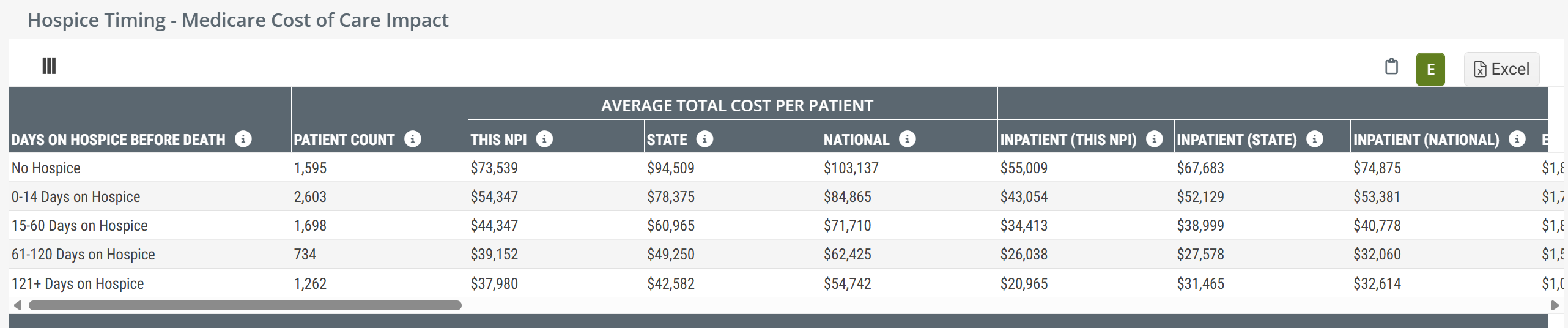 |
| The table in the image above only shows part of the metrics available. A complete image is shown below. | |
|
On
|
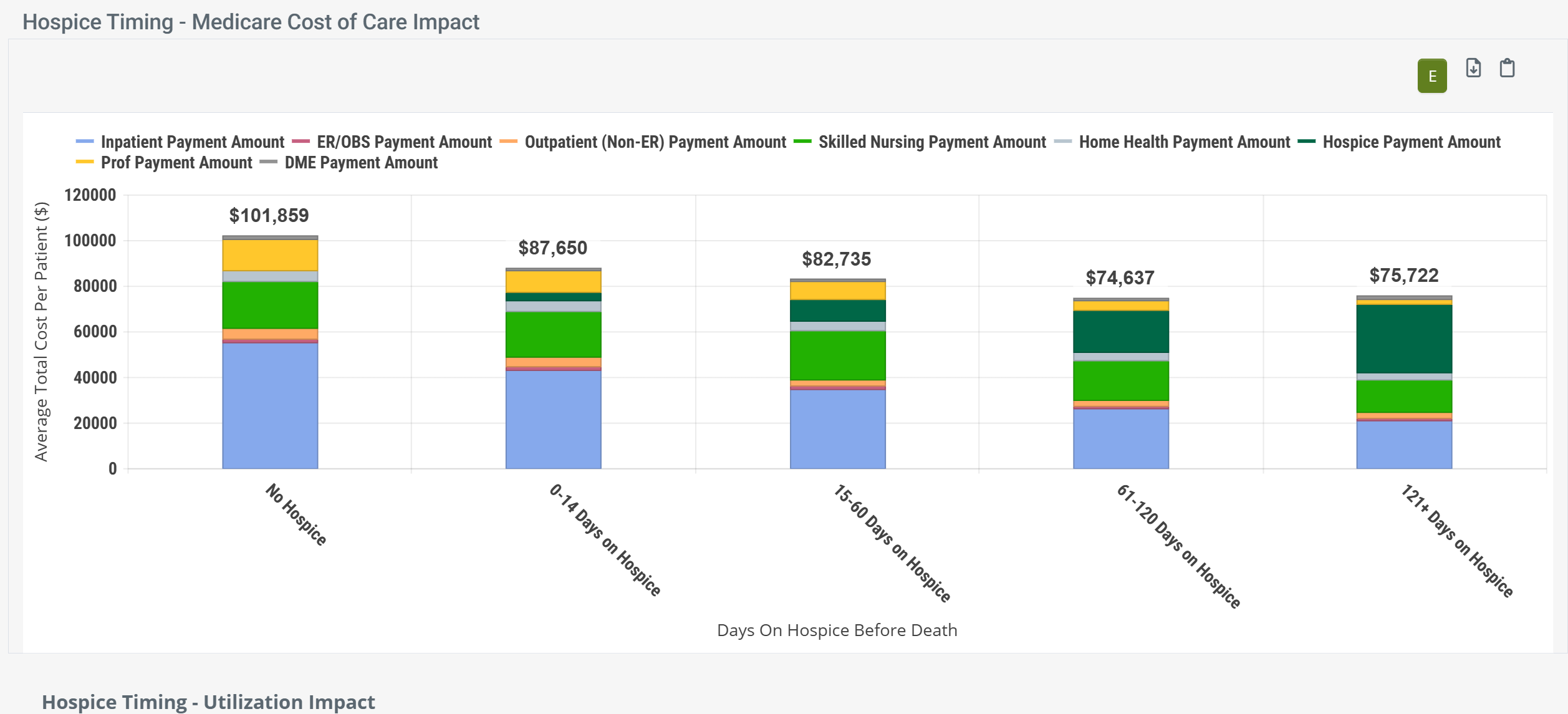 |
| When you hover over a bar in the Hospice Timing - Medicare Cost of Care Impact chart, the metrics for the different provider types represented in the chart are displayed. (image below) | 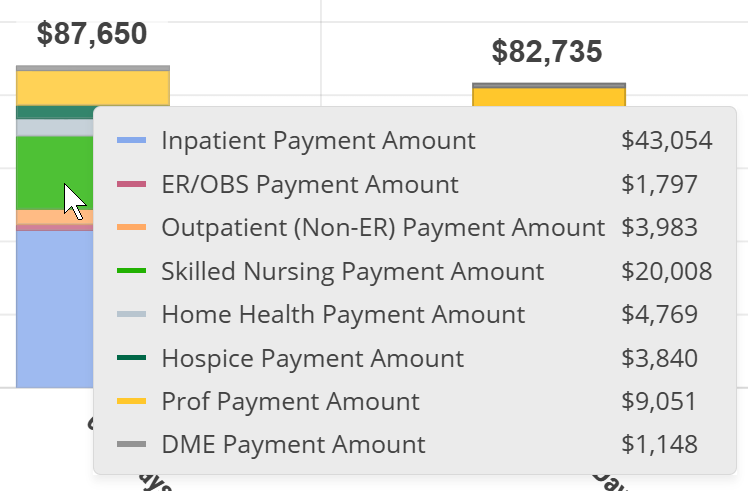 |
 To enlarge an image, click on it.
Value
The metrics in this table are designed to:
- Furnish insights into the financial and utilization impact of hospice timing on your own patient population
- Help hospice providers identify and enroll patients earlier, improving patient care while improving financial performance
- Provide benchmarking against state and national averages to guide clinical and operational strategies
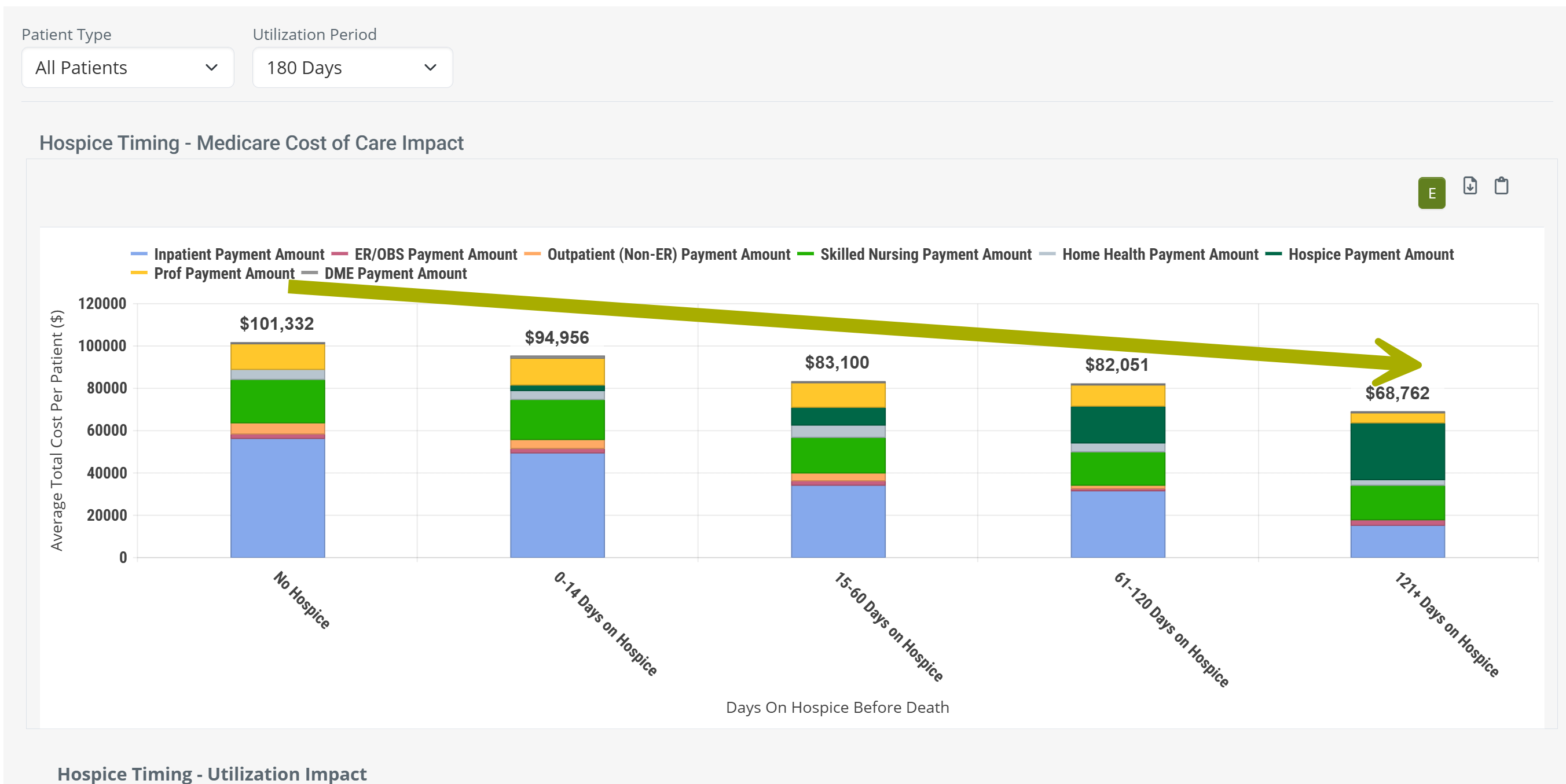
But let's make this simple: Behold a convincing example.
 Observations
- The chart shows the cost improvements from hospice, instantly and obviously.
- Being admitted to any level of hospice saves money over no hospice care.
- Longer stays save costs over shorter stays.
- Hospice is good, use hospice.
And, yes, you can customize the chart to show the same kind of trend for patients with different acuity levels and different chronic conditions. Customize your proof to numerous specific situations.
 Calculation
To determine which patients are included in costs, and to confirm which costs are counted, there are a few limits that are helpful to understand.
- Index event - since the Hospice Timing tables are designed to show the value of hospice, we start by identifying a patient's death. To be included in these metrics, the patient must have died. Patients who are still on hospice during the reporting period are not included in Hospice Timing metrics.
- Reporting period - the patient's death must have occurred during the one-year reporting period. This is the one-year period period ending on the last day of the most recently released data.
| The one year reporting period is identified at the top right of every page in Trella Insights. The relevant reporting period for this table is "Medicare Fee for Service (FFS)". The reporting period changes with each new release. |  |
- Discharge Reference period - from the patients who died during the reporting period, only patients who died within 180 days of discharge from the selected facility are included in the metric calculations.
-
No Hospice/Length of Stay - for patients that meet all of the above requirements, we break them up into the five categories shown in the chart and the table. The costs for these patients are displayed.
- No Hospice
- 0-14 Days on Hospice
- 15-60 Days on Hospice
- 61-120 Days on Hospice
- 121+ Days on Hospice
- Patient Type - You are able to use the dropdown filters to further limit the population from which the metrics are calculated into all patients, patients of a specific acuity level, and patients with specific chronic conditions.
- Lookback Period Before Death - Finally, you are able to choose a length of time from which the costs are calculated, 30 days, 60 days, and 180 days. Use the image and examples below to see how costs are calculated.
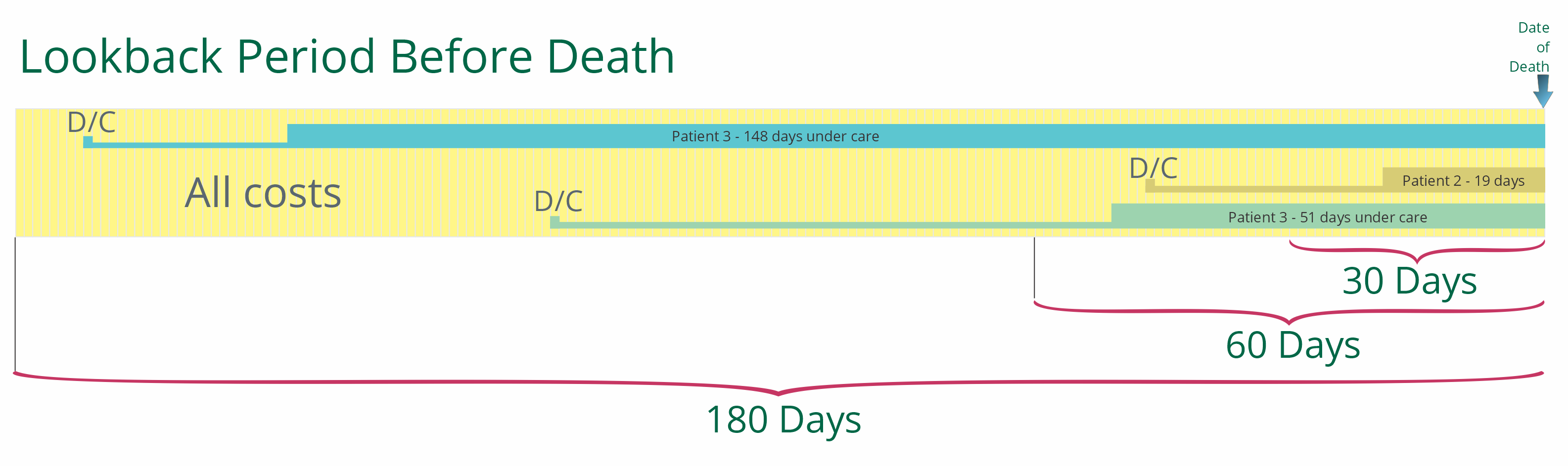
| The lookback period is selected using the dropdown filter. | |
Examples
Patient 1 was discharged 171 days before death and was on hospice care for the last 51 days.
- If we choose a 30 day period, only costs in the last 30 days would be counted. The costs would be used in the average for the column, 121+ days on Hospice, because the patient was on hospice 148 days.
- If we choose a 60 day period, costs that occurred in the last 60 days would be counted. The costs would be used in the average for the column, 121+ days on Hospice, because the patient was on hospice 148 days.
- If we choose a 180 day period, costs that occurred in the last 180 days would be counted, even though some costs occurred prior to their hospice stay, and prior to their discharge. The costs would be used in the average for the column, 121+ days on Hospice, because the patient was on hospice 148 days.
Patient 2 was discharged 47 days before death and was on hospice care for the last 19 days.
- If we choose a 30 day period, only costs in the last 30 days would be counted, even though some costs occurred prior to hospice care. The costs would be used in the average for the column, 15 - 60 days on Hospice, because the patient was on hospice 19 days.
- If we choose a 60 day period, costs that occurred in the last 60 days would be counted, even though some costs occurred prior to hospice care, and prior to their discharge. The costs would be used in the average for the column, 15 - 60 days on Hospice, because the patient was on hospice 19 days.
- If we choose a 180 day period, costs that occurred in the last 180 days would be counted, even though some costs occurred prior to their hospice stay, and prior to their discharge. The costs would be used in the average for the column, 15 - 60 days on Hospice, because the patient was on hospice 19 days.
Patient 3 was discharged 116 days before death and was on hospice care for the last 51 days.
- If we choose a 30 day period, only costs in the last 30 days would be counted. The costs would be used in the average for the column, 15 - 60 days on Hospice, because the patient was on hospice 51 days.
- If we choose a 60 day period, costs that occurred in the last 60 days would be counted, even though some costs occurred prior to hospice care. The costs would be used in the average for the column, 15 - 60 days on Hospice, because the patient was on hospice 51 days.
- If we choose a 180 day period, costs that occurred in the last 180 days would be counted, even though some costs occurred prior to their hospice stay, and prior to their discharge. The costs would be used in the average for the column, 15 - 60 days on Hospice, because the patient was on hospice 51 days.
The image above has all three patients day of death the same in order to simplify the illustration. In real life, the dates of death could at any time in the one year reporting period and we would then look back from that date.
Chart versus Table
Since the content in the chart view and table view are the same, but presented differently, let's compare using the following image.
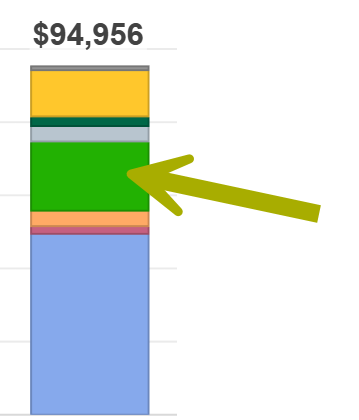
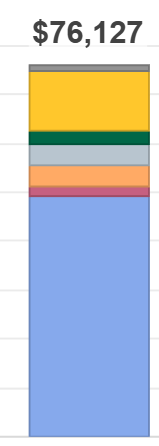
The image shows a small section of the table view with a section of the chart above including the metrics that are displayed when you hover over a bar in the chart. Specifically, we hovered over the "No Hospice" bar.
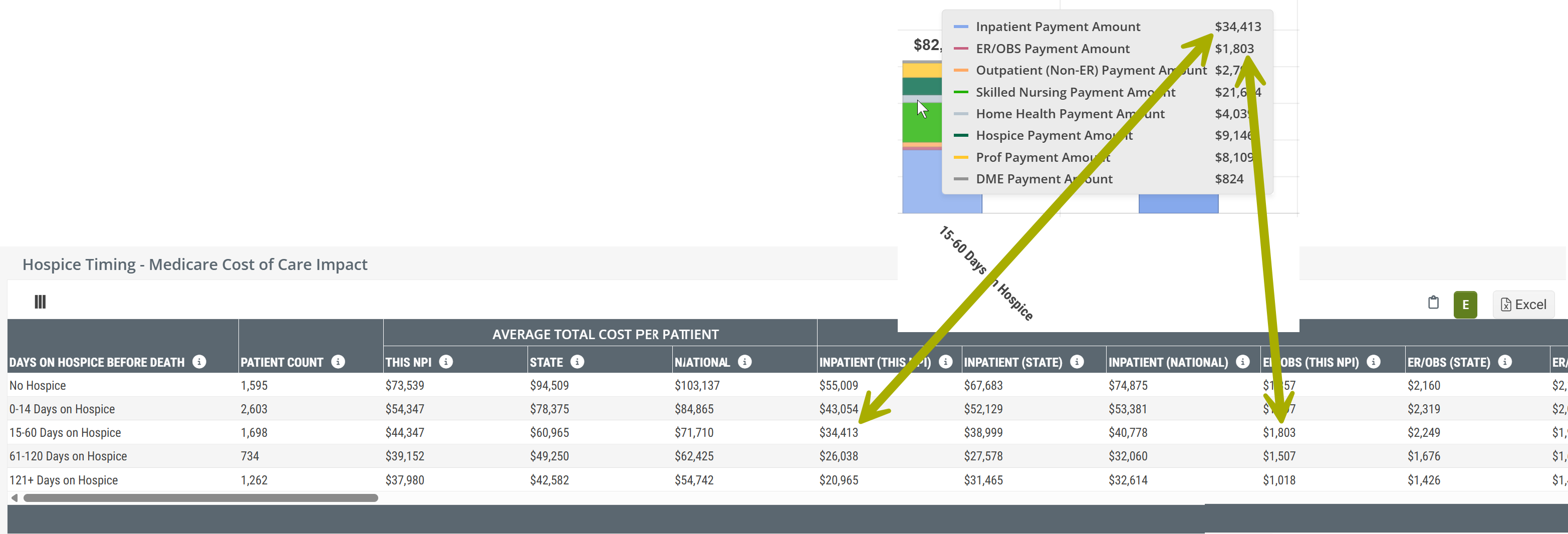
Things to notice:
- The chart makes it much easier to visualize trends.
- When you hover, you reveal specific metrics from the table. The arrows above show how the same metrics, related to your selected NPI, are included in the chart. The rest of the metrics shown in the hover are in the part of the table to the right that is not being shown.
- The table, in addition to other metrics, includes the state and national averages for comparison.
 We strongly suggest comparing the table to the chart. The chart is a powerful visual presentation that shows how earlier hospice impacts costs and utilization. The table provides a lot more detail for comparison and evaluation.
Metric Details - Hospice Timing - Medicare Cost of Care Impact
The table includes ALL of the metrics included in the chart and more. The following list shows all metrics in the table which are also shown in the chart. Use the following image to compare to what you see on the Analyze page.
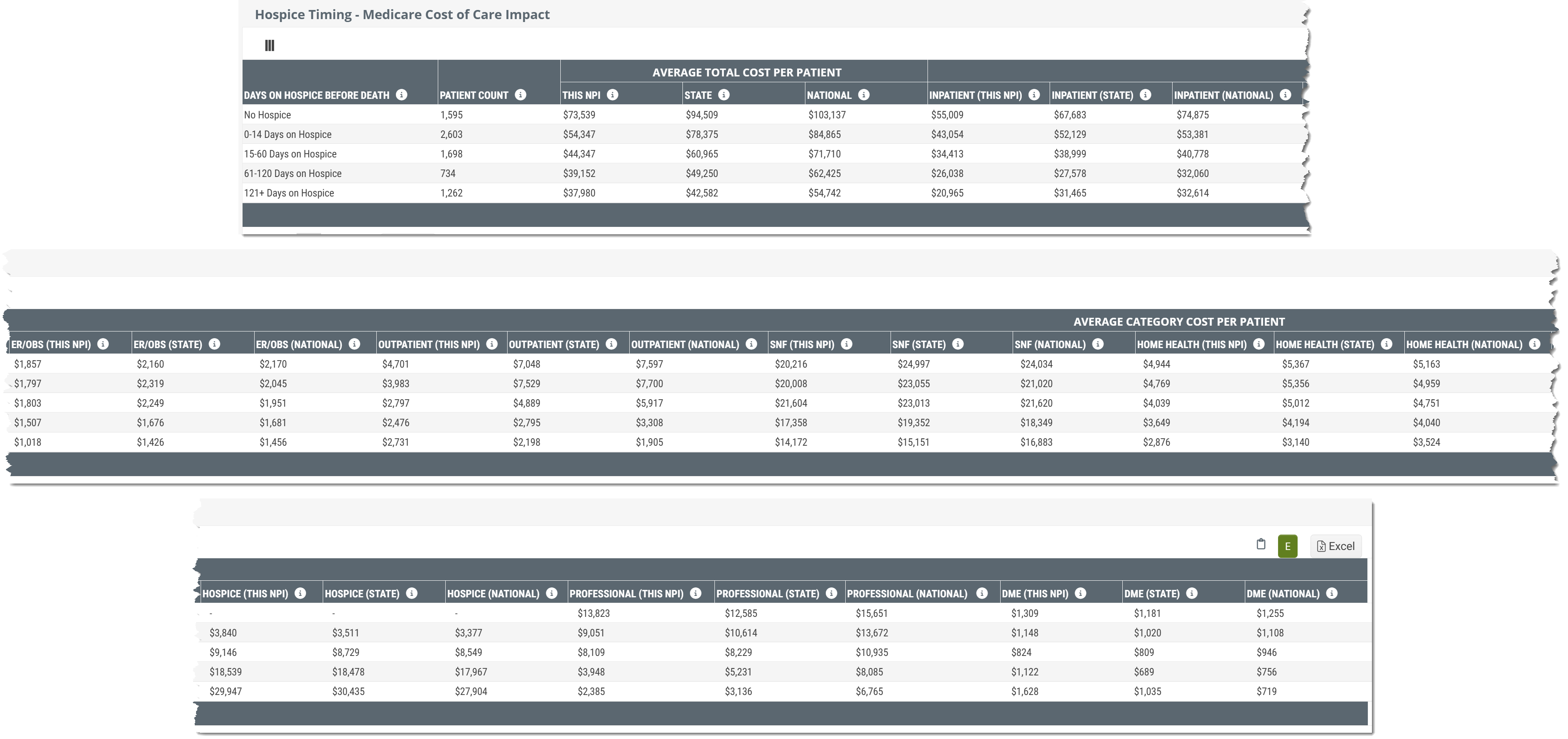
We broke the table up into parts so that the whole table is presented in a way that is more readable. You can click on the above image to enlarge it, of see the complete table, here.
Metric Name |
Description |
|
| Days on Hospice before Death | This column shows the reference time period from which the metrics in the same row are calculated. For example, the row "No Hospice" calculates metrics from claims of patients discharged from the selected facility who died without receiving any hospice care. The remaining rows contain metrics for patients who received the listed number of days under hospice care. | |
| Patient Count |
The count of distinct patients who died during the most recent 4 quarters who were discharged from the selected facility up to 6 months (180 Days) prior to death and who received the length of care listed in the row. |
|
|
| ||
|
Average Total Cost Per Patient |
Average total Medicare spend for patients discharged from the selected facility who received the length of care listed in the row.
|
|
|
Average Category Cost per patient
|
Inpatient | The average Medicare spend per patient on Inpatient claims (includes LTACH & IRF) for patients discharged from the selected facility up to six months prior to death and who received the length of hospice care listed in the row. |
| ER/OBS | The average Medicare spend per patient on ER and observation claims for patients discharged from the selected facility up to six months prior to death and who received the length of hospice care listed in the row. | |
| Outpatient | The average Medicare spend per patient on outpatient claims for patients discharged from the selected facility up to six months prior to death and who received the length of hospice care listed in the row. | |
| SNF | The average Medicare spend per patient on skilled nursing claims for patients discharged from the selected facility up to six months prior to death and who received the length of hospice care listed in the row. | |
| Home Health | The average Medicare spend per patient on home health claims for patients discharged from the selected facility up to six months prior to death and who received the length of hospice care listed in the row. | |
| Hospice | The average Medicare spend per patient on hospice claims for patients discharged from the selected facility up to six months prior to death and who received the length of hospice care listed in the row. | |
| Professional | The average Medicare spend per patient on professional (Part B) claims for patients discharged from the selected facility up to six months prior to death and who received the length of hospice care listed in the row. | |
| DME | The average Medicare spend per patient on DME claims for patients discharged from the selected facility up to six months prior to death and who received the length of hospice care listed in the row. | |
 Also, all of the metrics apply to the patient populations you selected with the filters.
 |
Hospice Timing - Utilization Impact table
For patients treated by a selected facility who died, we break that population into the following categories:
- No Hospice
- 0-14 Days on Hospice
- 15-60 Days on Hospice
- 61-120 Days on Hospice
- 121+ Days on Hospice
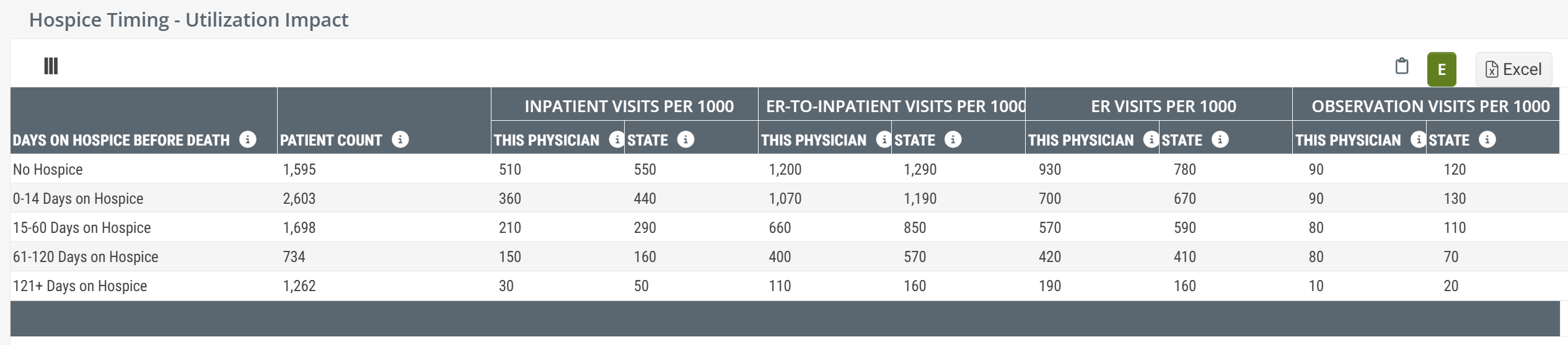
You can see these categories listed on the left side of the pictured table.
Data Presentation
|
Off
|
 |
|
On
|
There is no chart view for the metrics in this table. The table above is shown with Chart View on. |
To enlarge an image, click on it.
For each of these categories, this table provides overall patient counts for each category, and projected counts (per 1000 patients) for each of four different hospital levels of care.
Value
In light of the cost savings and benefits to patients and families that hospice care provides over hospitals for patients near the end of life, this table verifies the value of hospice care. For example, for each type of hospital visit, the table shows that early admission into hospice care is better than later admission, and that any hospice care is better than no hospice care at all.
This table makes it almost too easy to prove that getting hospice appropriate patients admitted to hospice care early is preferable. If you want to use these metrics in this way, most of the time you can prove this point using either the provider's metrics or the state averages.
Metric Name |
Description |
| Days on Hospice before Death | This column shows the reference time period from which the metrics in the same row are calculated. For example, the row "No Hospice" calculates metrics from claims of patients discharged from the selected facility who died without receiving any hospice care. The remaining rows contain metrics for patients who received the listed number of days under hospice care. |
| Patient Count | The count of distinct patients who died during the most recent 4 quarters who were discharged from the selected facility up to 6 months (180 Days) prior to death and who received the length of care listed in the row. |
| Inpatient | The average number of inpatient visits (not through the ER) per 1,000 patients who received the length of care listed in the row. |
| ER-to-Inpatient Visits per 1000 | The average number of inpatient visits (admitted through the ER) per 1,000 patients who received the length of care listed in the row. |
| ER Visits per 1000 | The average number of ER visits discharged home (not admitted to inpatient or observation) per 1,000 patients who received the length of care listed in the row. |
| Observation Visits per 100 | The average number of observation visits per 1,000 patients who received the length of care listed in the row. |
|
Usage
Although the image shows metrics from a hospital Analyze page, the Hospice Timing table for a physician would provide the same use case.
 The value of hospice
In light of the cost savings and benefits to patients and families that hospice care provides over hospitals for patients near the end of life, this table verifies the value of hospice care. For each type of hospital visit, the table shows that early admission into hospice care is better than later admission, and that any hospice care is better than no hospice care at all. We will look at the numbers below.
This table makes it almost too easy to prove that getting hospice appropriate patients admitted to hospice care early is preferable. If you want to use these metrics in this way, most of the time you can prove this point using either the provider's metrics or the state averages.
 State metrics for comparison
In addition to metrics specific to the selected provider, the table provides state averages for similar providers. The comparative nature of these metrics allows you to see how your selected provider performs against peers. If your selected provider underperforms or overperforms against peers, you will want to do some careful evaluation of the demographics of the patient population to find out why.
You will want to be careful relaying these metrics to a physician. Although for a high performer you could communicate, "Hey, you're doing great!" it is important to dig in on why the physician's metrics are so good. If the metrics show poor performance against the state averages, you would want to only provide these insights in a context of trust and with a persuasive message of how you can help.
Keep in mind that these metrics also reflect on the care provided by all hospices that treated the provider's patients. This means that, for this table, the metrics do not provide insights into the success of your agency.
 Patient mix between categories
The patient counts are a breakdown of the selected provider's patients who died during the reporting period.
The sample image of a provider's metrics (above) demonstrates the need. This patients break down thus:
|
|
Considering the value of hospice care, these numbers are upside down. The message is clear. This provider needs help to identify hospice appropriate patients and get them admitted to hospice earlier.
 Hospital events
There are four hospital events that we track for hospice patients in this table.
- Inpatient Visits per 1000 - A patient is admitted to a hospital for inpatient care.
- ER-to-Inpatient Visits per 1000 - a patient is admitted to inpatient care through the emergency room.
- ER Visits per 1000 - a patient is taken to the emergency room, but not admitted for other additional care.
- Observation Visits per 1000 - a patient stays overnight for observation but is not admitted to inpatient care.
The metrics in this table are based on visit counts, not patient counts. That is, a single patient could be counted multiple times for any level of hospital care, and counted for more than one type of hospital care.
|